Roy H. Williams, Wizard of Ads, and What He Taught Me About Radio That Still Matters
Roy H. Williams is a Texas-based ad writer and teacher who became famous in radio circles as “The Wizard of Ads.” The nickname isn’t about magic; it’s his playful way of describing the science of words, repetition, and human behavior. His books and seminars shaped a generation of radio copywriters, and I was fortunate to be introduced to his ideas and read his many books, early in my career.
When people hear I’m back in radio after spending more than 15 years in digital marketing and design, they usually ask:
“Does radio even work anymore?”
Fair question. I’ve lived in both worlds.
My answer lives in a stack of dog-eared pages from Roy H. Williams’ Wizard of Ads and the years I spent as Market Research Manager at Corus Entertainment before I left for digital.
I helped sales teams find ideal customers and build schedules that worked for three very different Calgary stations: QR77 (news/talk), Country 105, and Power (which became Peak, then Q107).
Three formats. Three audiences. One budget per client.
That role gave me a front-row seat to test Roy’s ideas with real advertisers, real budgets, and real competition with other radio stations and other media. What I learned then shapes how I build campaigns for Shine FM clients today.
This is my Wizard of Ads cheat sheet for small and mid-sized businesses who want their radio to work harder.
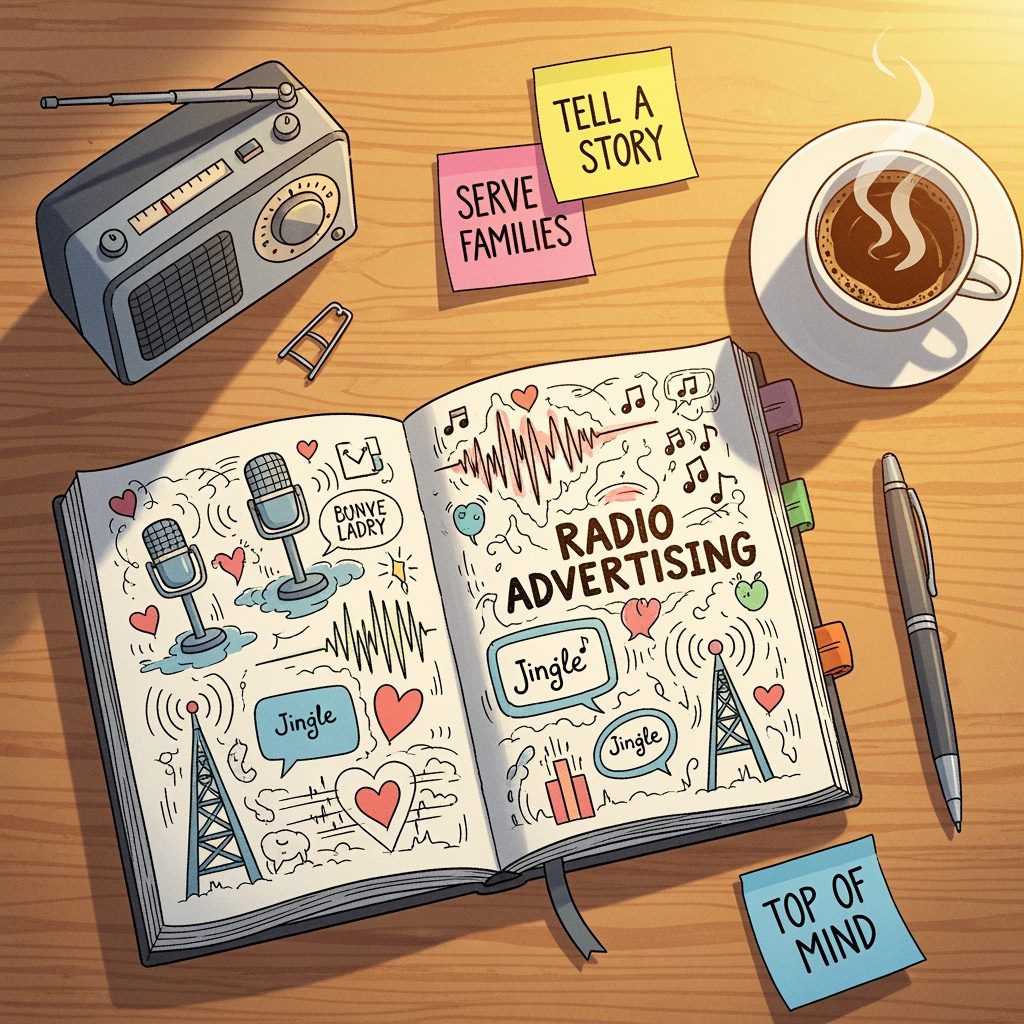
1. Dead Cows Everywhere: Stop Worshipping the Wrong Numbers
In “Dead Cows Everywhere,” Roy takes aim at three “sacred cows” of advertising: demographic targeting, gross rating points, and media mix.
His argument? You can hit the “right” demographic, rack up impressive rating points, and sprinkle your budget across multiple media, and still fail.
Why? Most campaigns obsess over who and how many, while neglecting what they actually say.
What landed for me as a research manager:
You cannot spreadsheet your way out of a weak message.
You can buy perfect reach and frequency. But if your ad is boring, confusing, or forgettable, you’re just paying to repeat a bad story.
Takeaway for Shine FM advertisers
Reach and frequency still matter, but they’re supporting actors. The star of your campaign is always the message:
- Is it emotionally true?
- Is it different from what your competitors say?
- Is it worth repeating 50 times without everyone switching the channel?
When I work with Shine FM clients, we start with story and strategy, then choose schedules that let that story actually sink in.
2. Category Dominance: Be Known for One Thing
Roy’s thesis in “Category Dominance”: the goal of branding isn’t awareness for everything you do. It’s to own a simple, specific position in the listener’s mind.
That takes courage. It’s much safer to say “We’re for everyone” or “We do a little bit of everything.”
The problem? “Everyone” never feels spoken to, and “everything” is impossible to remember.
Takeaway for Shine FM advertisers
Ask and answer one hard question: “If I could only be known for one thing in my community, what would it be?”
For a Christian school: “A place where faith, academics, and character grow together.”
For a family dental clinic: “Gentle, honest dentistry for people who hate going to the dentist.”
For a trades business: “The contractor who actually calls you back.”
Once you know your one thing, every spot, every line, every image points in the same direction. Over time, you stop being “just another advertiser” and become the name in that mental category.
3. The Goose and the Gander: You Are Not a Tiny Big Brand
Roy’s point: what works for big corporate “geese” can be poison for the independent “gander.”
Big brands can afford full media mixes, math-heavy quarterly planning, and campaigns designed to please shareholders. Small and mid-sized businesses live in a different world. Every dollar needs to pull its weight. You don’t have the luxury of “image campaigns” with fuzzy results.
When I was building schedules at Corus, business owners who tried to imitate big brands by spreading thin across too many stations usually felt disappointed. The ones who picked a lane and stayed in it? They quietly built strong local brands.
Takeaway for Shine FM advertisers
You don’t need a big brand media mix. You need:
- One clear message
- Enough repetition for that message to stick
- A plan you can commit to for months, not days
The question isn’t “How many different places can I show up?” It’s “Where can I afford to show up consistently so people actually remember me?”
For many community-minded, family-friendly businesses, Shine FM is that lane.
4. Radio Scheduling: Branding vs. Events (They’re Not the Same Thing)
This is where my worlds of research and storytelling collided.
Roy makes a crucial distinction that most advertisers miss: event campaigns and long-term branding are fundamentally different animals and should never be treated the same way.
Here’s what advertisers get wrong: they confuse the two, or worse, they run nothing but event campaigns and wonder why their brand never gains traction.
Long-term branding is the foundation.
This is your core work. It’s about:
- Consistency over time
- Enough weekly repetition that listeners actually hear you several times
- A message that will still matter six months from now
- Building mental availability so people think of you first when they need what you offer
This is always-on. This is the patient work of becoming a name people know and trust.
Event campaigns live outside of branding.
These are tactical, short-term pushes for a specific sale, fundraiser, or concert. They need heavy frequency in a compressed window, spots stacked close to the date, and a clear call to action.
They work. They’re important. But they should be used sparingly.
Why? Because if you’re always in “event mode,” you never build the brand equity that makes those events more effective. You train people to wait for your next sale instead of thinking of you as the answer to their need.
“Station within the station”
Roy also offers a solution for tight budgets: focus on specific hours where your best customers are listening. Run enough spots in those hours that you become familiar to that slice of the audience.
You won’t reach everyone, but you’ll matter deeply to the ones you do reach.
I found this especially effective for small businesses with limited budgets. I could get them on QR77 News Talk, which although more expensive than most AM stations, was still less per spot than the FMs. And because it was a program format, I could sell ads within a specific program.
For example, a health-related advertiser like an MRI clinic within a health and wellness talk program. Three commercials a week in a single talk program resulted in a highly effective campaign. The audience was right, the context was right, and the repetition built recognition fast.
A small budget spread thin across the whole station went unnoticed. The same budget focused in the right program built real momentum.
Takeaway for Shine FM advertisers
My first question is always: “Are we trying to move people this month, or mould memory this year?”
For Shine FM clients, that usually means:
- A core, always-on schedule to build top-of-mind awareness (this is your brand work)
- Occasional short bursts of heavier frequency for specific events (used strategically, not constantly)
The foundational work is branding. Events are the exception, not the rule.
5. Radio as Word-of-Mouth, Turned Up
One of my favourite lines from Roy’s work:
“Radio is word-of-mouth advertising evolved to its highest level.”
When you think of radio this way, everything clicks:
- It’s personal: you’re in the car, in the kitchen, in the shop with people
- It’s intimate: the announcer feels like a friend, not a billboard
- It’s repetitive in a good way: the story can unfold over weeks and months
For a station like Shine FM, this effect is amplified by shared values. Listeners trust the environment, so when you show up with honesty, humility, and a clear promise, you’re not just “running spots.” You’re joining a conversation that’s already warm.
Takeaway for Shine FM advertisers
If you wouldn’t tell the story that way to a friend over coffee, don’t put it in your ad.
Instead:
- Talk like a human, not a brochure
- Admit the real problems your customers face
- Offer a path that feels doable and kind
- Let your values shape how you talk about what you do, not just where you advertise
How This Shapes the Way I Work with You Today
When I sit down with a Shine FM advertiser, Roy’s fingerprints are all over the process.
We start with your category: What do you want to be known for in this community?
We shape a simple, memorable story: Who are you here to help? What are they struggling with? What becomes possible when they work with you?
We build a schedule that matches your reality: Budget, seasonality, goals. Event-driven bursts vs. long-term consistency. “Station within the station” where useful.
We measure the right things: Traffic quality, inquiry volume, and story recall. Not just “how many spots” or “how many impressions.”
We stay flexible: Small and mid-sized businesses live in the real-world economy. Plans must bend without breaking when conditions change.
Radio doesn’t create miracles on its own. But when you line up a clear category, a truthful story, and a schedule you can commit to, radio becomes one of the most efficient ways to plant that story in people’s minds and hearts.
Especially on a station where the audience already cares about families, values, and how they spend their money.
If you’d like to talk through how these principles could shape a Shine FM campaign for your business, I’m happy to walk through it with you.
Same researcher brain. Same love for good radio. Just better tools, more experience, and I actually want to help you tell your story to an audience who wants to listen.

Related Articles

Local Business, Local Spotlight, Shine FM
Advertising, Local Business, Marketing that Works, Marketing Tips