
Vibe Coding: It Starts With an Idea
FaithFinder started the way many good ideas do… with a conversation.
I met Dave at a live on location event for the radio station in Edmonton. Being a savvy businessman, he quickly moved our discussion from radio advertising to a bigger question: how do you solve the problem of marketing for churches? I left that meeting very much intrigued, and curious about what I could build that might solve some of the problems he brought forward.
And so it began, as a basic concept: create a community around faith.
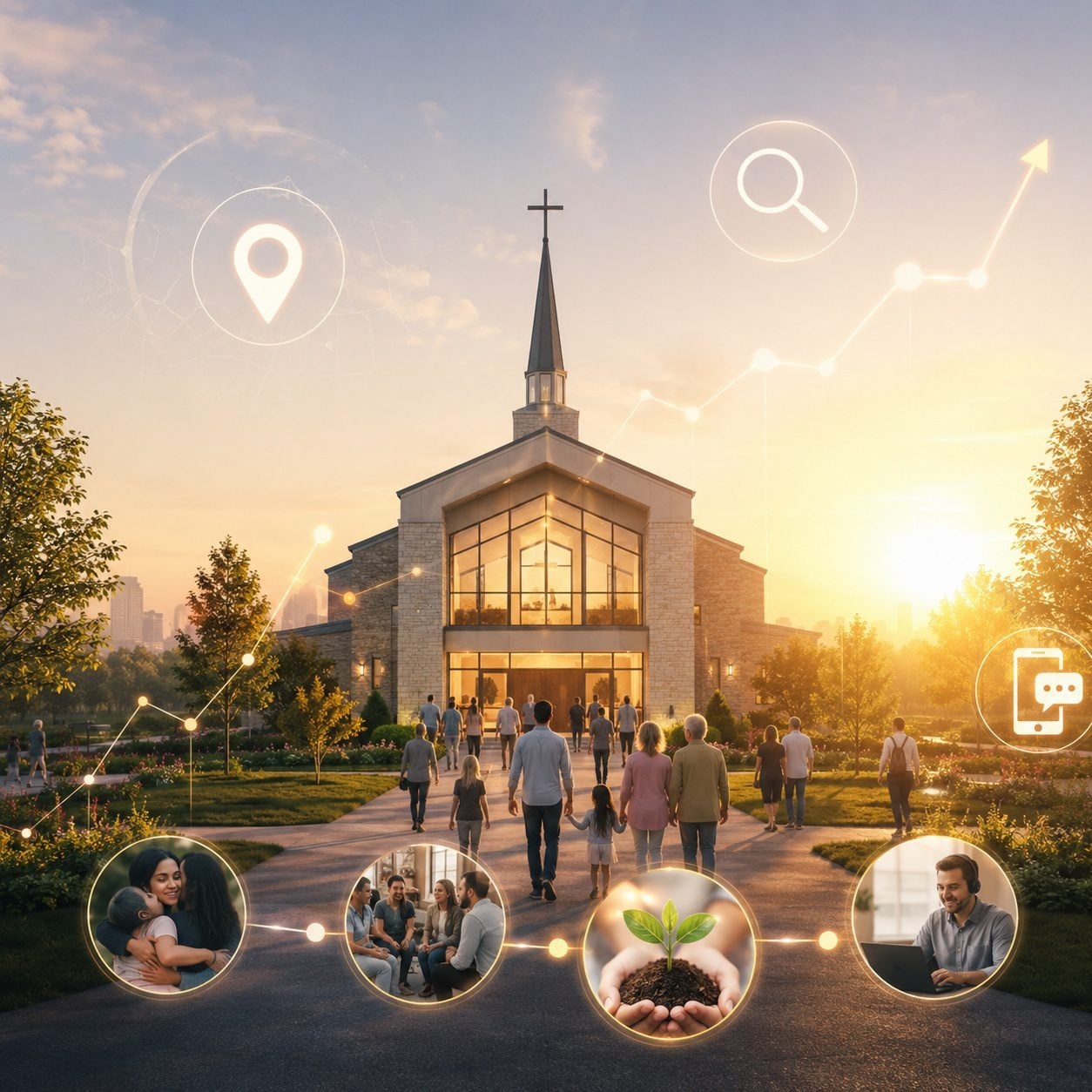
That concept is now FaithFinder.ca, an Alberta-first directory and community for churches, schools and faith-based businesses, with the goal of expanding across Canada. It’s free to join. And it was built entirely through vibe coding.
I Am Not a Developer
I’ve spent nearly 30 years in radio, at Rawlco, Corus, Harvard, Golden West and Bell Media. I know radio advertising inside and out, and I know how to listen for the problem underneath a client’s question. Until recently, though, knowing the problem and being able to build the answer were two very different things.
That gap is closing, and faster than most marketers and business owners realize.
So What Is Vibe Coding, Exactly?
In early 2025, AI researcher Andrej Karpathy gave a name to something a lot of people were already doing: building software by describing what you want to an AI in plain language, then shaping it through conversation. He called it vibe coding, and the name stuck.
You don’t write the code. You say what you want, the AI writes the code and shows you what it made, and you react. Then you go around again. And again.
If that sounds too easy, it isn’t. It’s easy to start. Doing it well is another matter, and it’s the part most people skip.
From a Concept to a Community
“Create a community around faith” is a good idea. It is not a platform. Getting from one to the other took a lot of conversation, and not all of it was with people.
I didn’t build FaithFinder with one AI. I built it with two. ChatGPT and Claude worked in tandem, each taking on the parts it does best, and I moved between them the way you’d move between two colleagues with different strengths. When one got stuck, the other often had a fresh angle.
First it was a directory, a place where churches, schools and businesses could be found. Then came smart databases to organize who’s listed, where they are and what they offer. After that, the question of how a business could stand out became a Featured listing with its own custom landing page. Building a new page for every business sounded like a lot of work, so I asked how to make it repeatable. The answer was a template system where the brand details (colours, logos, names) live in one place, so each new page starts ready to go.
Behind all of it sits a GoHighLevel (GHL) CRM with automations that handle most of the heavy lifting. The automations send welcome emails, collect data and handle the processes that would otherwise eat up my days. That means a platform built to serve churches, schools and businesses across Alberta, and eventually Canada, runs largely on its own, without a team of developers and without a big budget.
None of those pieces were in the original idea. Each one came from asking “what’s the next problem?” and working it out one conversation at a time.
This fall, I’m starting with people I know and trust, business owners I’ve connected with through radio. Just like it began, it continues as a conversation.
A Second Example: “Nothing New”
Not long ago, I was talking radio advertising with Dwayne at Automaxx. Automaxx sells used cars, and mixed in with the everyday inventory are some genuinely cool classics. When the phrase “nothing new” came up, I could see it land with him. I couldn’t let it go.
So I built him something. Not another proposal, but an interactive contest page with two games on it: a Dash for Cash, and a Stick the Shift challenge built around the older, more unique models on the lot. It’s a demo, so it isn’t collecting entries yet, but you can play with the Automaxx contest page here.
When I started the stick shift game, I didn’t know how to use the coding tool I opened. I knew what I wanted it to feel like, though. I wanted the shifter to look like the real thing: a glossy black ball with the pattern engraved on top and reverse down and to the left. I wanted your left hand working the clutch and gas and your right hand working the gears.
None of that is code. All of it is direction. The AI handled the code. My job was to keep saying “closer,” “not quite,” and “what if we tried this instead?”
How It Actually Works
- You bring the idea. Who it’s for, what they should feel, and what they should do.
- The AI builds a first version.
- You react honestly.
- The AI revises, and you repeat.
The first version is rarely the good one. The good one shows up somewhere around the fifteenth “what if.”
Why This Matters for Local Advertising
Here’s what three decades in radio have taught me: radio advertising builds reach and trust like almost nothing else. People invite their favourite station into their kitchens, their cars and their workdays. When a trusted voice on air tells them about your business, they listen.
But what happens next? The listener hears your ad, picks up their phone, and goes… where? Too often the answer is a tired homepage or nowhere at all.
That’s the gap vibe coding fills for local advertising. Radio creates the moment, and digital marketing catches it. A game, a contest, a simple landing page that captures a name and email. For a local business owner, that piece no longer has to cost a fortune or take months. For radio sellers and marketers, it means walking into a meeting with something a client can actually use, instead of a promise on paper.
AI for Digital Marketers: A Collaborator, Not a Vending Machine
This is the part I most want you to hear.
Some people use AI like a vending machine. They put in a request, take whatever falls out, and walk away. The results look it: generic, flat, and a little bit like everyone else’s.
The people who do this well design on their feet. They ask the AI for ideas, not just output. They push back. They say “that’s close, but it feels cheap” and “what am I missing?” They treat it as a two-way conversation with a very fast, very patient creative partner, one who never sighs when you ask for just one more change.
The difference isn’t the tool. It’s the person sitting in front of it.
How I Use AI and Vibe Coding
So how do I actually do it? The honest answer is that I don’t treat AI like a tool. I treat it like a team.
I ask questions and give feedback as though I were speaking with a coder and a designer, not a machine. I share images, concepts and examples throughout the process, because showing beats telling, whether you’re briefing a person or an AI.
I ask for what seems impossible, just to see if it is. More often than not, it isn’t.
I also keep things organized, which may be the least exciting part and the most important. Every project gets its own folder, so everything is connected and contained in one place. The conversations inside a project can number in the hundreds or more, so I organize them by topic, which makes them easier to find later. I upload working files as foundation data, so the AI always has the background it needs and I’m never starting from scratch.
Then I build a cast. Within a project, I create personas: marketers, writers, coders, SEO experts, lawyers and advisors. Each one brings a different lens to the same problem. (A lawyer persona helps me ask better questions, but it doesn’t replace my lawyer.)
What grows out of all this is an ecosphere. It starts small, with one idea and one conversation, and it grows in depth as the project grows. By the time FaithFinder was taking shape, I wasn’t talking to a chatbot anymore. I was working inside a room full of collaborators who knew the project almost as well as I did.
10 Top Tips: How to Do Vibe Coding Well
1. Start with the idea, not the technology. “Create a community around faith” is a direction. “Build me a website” is a wish.
2. Brief it like you’d brief a person. Who is it for? Where will they see it? What’s the one thing they should do? The AI can’t read your mind any better than a new hire can.
3. Ask for the impossible. Ask “what would make this better?” and then ask for the thing you assume can’t be done. More often than not, it can. And if one AI runs out of ideas, ask another.
4. Show, don’t just tell. Give it a photo, a screenshot, a colour palette or a page you admire. My shifter came from a picture of a real one.
5. Change one thing at a time. Ask for ten changes at once and you’ll never know which one broke everything.
6. Test on your phone early and often. If radio is driving the traffic, your audience is holding a phone, not sitting at a desk.
7. Talk to it like a coder and designer, not a machine. You don’t need technical words, just honest ones. “The button is hard to find” is perfectly good feedback.
8. Give your project a home. Create a project folder, upload your working files as foundation data, and organize conversations by topic. When you’re hundreds of conversations in, you’ll be glad you did.
9. Get it working before you make it clever. The bells and whistles come after the core works, not before.
10. Know when to call for help. Vibe coding is wonderful for prototypes, demos, contest pages and small tools. When real customer data, payments or privacy are involved, get a second set of eyes on it.
What to Avoid
- Launching without testing. A page that breaks on a phone is worse than no page at all.
- Collecting data you aren’t ready to protect. If you’re gathering names and emails, handle them properly and know the contest rules in your province. Once information is out there, you don’t get it back.
- Falling in love with the first draft. It’s a starting point, not the finish line.
- Losing the message. A clever page that has nothing to do with the brand or the campaign is just a toy.
- Letting the tool lead. You bring the idea, the judgment and the relationships. The AI brings speed. Don’t mix those up.
It Starts With a Conversation
Dave didn’t ask me to build a website. He asked a question about a problem he cared about, and I couldn’t stop thinking about it. Dwayne didn’t ask for a game. He reacted to two words.
Good marketing has always started that way, with a conversation and someone willing to say “what if?” out loud. What’s new is how fast you can get from that idea to something real in front of real people.
I believe the marketers and business owners who win in the next few years won’t be the ones with the biggest budgets or the fanciest tools. They’ll be the ones who listen well, stay curious, and aren’t afraid to build it out loud. So pick one idea, start the conversation, and keep going until it feels right.

Related Articles
Digital, Local Spotlight, Marketing that Works, Uncategorized

Insights, Local Business, Marketing that Works, Marketing Tips
Advertising, Local Business, Marketing that Works, Marketing Tips