
Marketing that Works
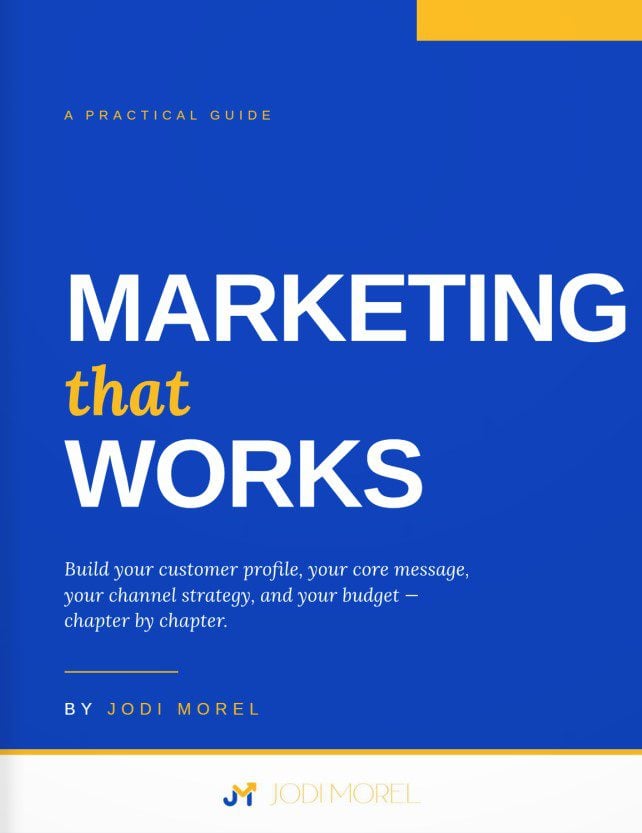
Marketing That Works is a practical workbook for business owners who want clearer messaging, stronger trust, and a marketing plan they can actually use.
Marketing That Works
Written by Jodi Morel, this guide walks you step by step through the foundations most marketing skips: understanding your best customer, naming the real problem you solve, building a message that sounds like you, identifying where trust breaks down, choosing the right channels, setting a realistic budget, and creating a focused 90-day plan.
This is not a book about chasing trends or doing more marketing for the sake of it. It is a working guide for building marketing that earns attention, creates confidence, and helps the right customers take the next step.
At the heart of the book is one question every business owner should carry into their website, ads, reviews, follow-up, and customer experience:
Does this make it easier or harder for someone to trust us?
For business owners launching, growing, or refining their brand, Marketing That Works helps turn scattered ideas into a clear customer profile, core message, channel strategy, budget framework, and practical action plan.
Want More?
Enter your name and email below and receive:
- The editable workbook — a fillable PDF version of the book you can complete on screen, save, and come back to
- A custom Marketing That Works AI assistant — trained on the book’s framework so you can ask questions and apply it to your specific business
- A free 30-minute marketing snapshot call with Jodi — a real review of where your marketing is strong and where the gaps are
- First access to new tools and resources as they launch
The Honest Marketing Budget Calculator
The most common error in marketing budgets is not the percentage. It is the number that percentage is applied to. This calculator works through your real numbers first — then shows you what an honest budget looks like.
Last year’s reality
Use your actual numbers from last year, not what you wish they were. The honesty here is what makes the rest of the calculator useful.
Don’t include your own pay here. Owner compensation comes out of net afterward.
This year’s projection
Honest projection beats optimistic projection. If last year was $300k, this year is rarely $600k. Stay grounded.
Three honest budget options
A practical 5–10% range applies to most service businesses. 15% is for businesses where growth is the explicit goal and operations can absorb the volume.
| Rate | Per year | Per month |
|---|---|---|
| 5% | $0 | $0 |
| 10% Rule of thumb | $0 | $0 |
| 15% | $0 | $0 |
What is the smallest amount you can confidently commit to for ninety days, without disrupting the business?
That is your honest starting budget — not the rule of thumb, not the aspiration. Start there. Grow it as the work proves itself.
Marketing Budget Allocation
Once you know how much to spend, the next question is where it should go. This tool uses your Trust Snapshot results from Chapter 1 to recommend an allocation that fits your actual stage — not a generic pie chart.
Your monthly marketing budget
Enter the monthly budget you committed to in the Budget Calculator (or whatever amount you can sustainably spend each month).
Your Trust Snapshot
In Chapter 1, you completed the Trust Snapshot worksheet. Record your honest score on the five items that most affect where your budget should go. Foundation gaps pull money away from visibility — because visibility budget leaks through a weak foundation.
Your stage
Where the business is right now changes how a budget should be split.
Your four-tier allocation
Based on your Trust Snapshot and stage. The percentages shift when foundation gaps are present — because visibility spend that runs into a weak foundation is wasted.
Visibility channel options
These are the channels your visibility tier could fund. The book argues against generic dollar splits across channels — choose channels by customer fit, not formula. The labels below tell you which channels are realistic at your visibility budget.
Of the foundation gaps you identified, which one will you actually fix in the next thirty days?
Knowing five things need work is not the same as fixing one. Pick the gap that — if closed — would have the biggest effect on whether visibility spend converts. Write it down so you remember what you committed to.