
By Jodi Morel
On July 7, 2026, Rogers closed six radio stations across Calgary, Vancouver, Halifax and Kitchener. In Calgary, listeners tuned in to 660 NewsRadio and heard a recorded message instead of a newscast. News 1130 traffic reporter Alexander Carrigan told CBC News he learned his station was closing when he heard the recorded message while driving to work. Six stations were gone in a single morning.
Rogers called it a difficult but necessary decision. I call it the predictable end of a story I’ve been watching unfold since 1998.
And this one was personal. Long before it was 660 NewsRadio, that frequency was 660 CFFR, Rawlco’s AM station in Calgary. My first station. The signal Rogers silenced this month is the one where my radio career began.
The Smell of Ink
I took Journalism at SAIT in 1993 and entered the media industry in its heyday. As a student, I toured the massive Calgary Herald building, and I’ve never forgotten it. The newsroom was abuzz with writers and reporters. Downstairs, the presses were enormous, loud and alive: paper swishing, machines banging, the smell of ink hanging in the air. I stood there in awe. You could feel it in the building itself, the sense that something important happened inside those walls.
Back then, local mattered. I remember riding the C-Train to school and watching everyone around me reading either the Sun or the Herald. We were told the Sun was designed as a tabloid specifically so it could be read on the commute, folded in one hand while you held the rail with the other. An entire newspaper format, built around the rhythm of a Calgary morning. And there was no shortage of debate, and let’s be honest, snobbery, over whether you were a Herald reader or a Sun reader. The Herald, of course, was REAL news. Or so Herald readers and Walter Nagel, my instructor and a Herald alumnus, would tell you. These were the things I noticed. Things that mattered before iPhones were invented, when the person next to you on the train was reading about your city instead of scrolling past it.
When I graduated, the plan was print. But print jobs were nearly impossible to find unless you were willing to live somewhere remote, so when I spotted a radio station advertising for a sales assistant in the careers section of the Herald, I leapt at the opportunity. Ironically, my radio career started in the pages of the very newspaper that made me fall in love with this business.
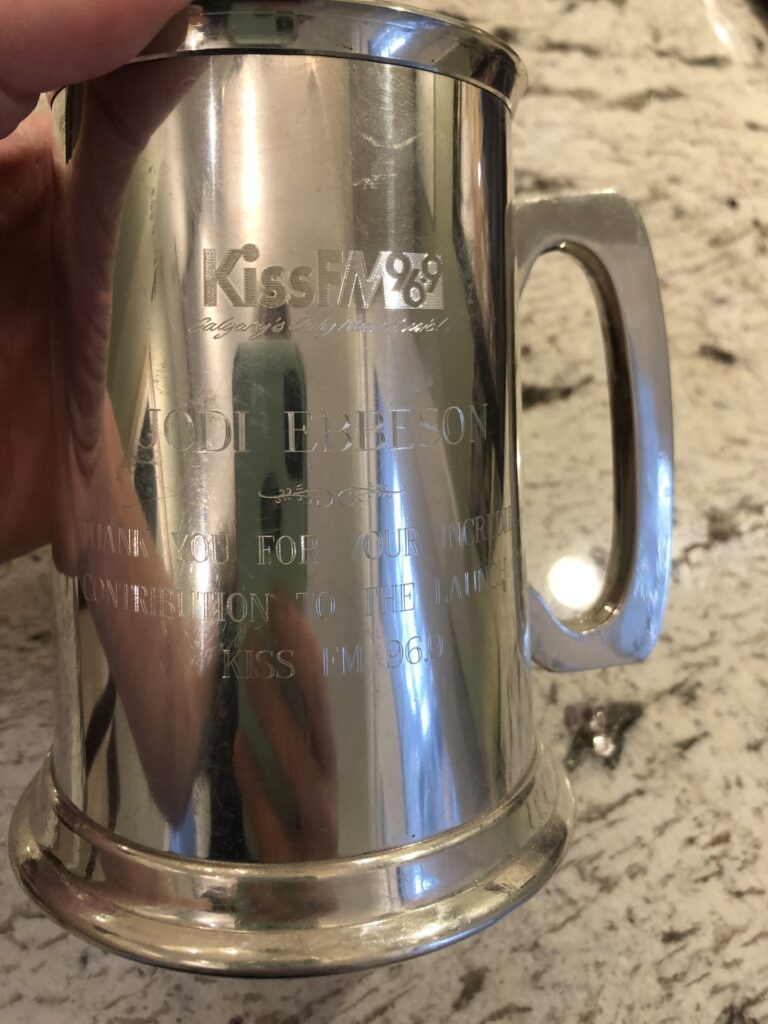
That’s how I landed at Rawlco, as a sales assistant at 660 CFFR, and I was barely a month in when I witnessed my first station launch. At 1 p.m. on June 3, 1996, our brand-new FM sister, Kiss 96.9, went live, the first new FM station Calgary had seen since 1982. It was amazing. My memory is that the first song was Hootie & the Blowfish’s “Only Wanna Be with You,” and thirty years later, I still think of that day every time I hear it. Listeners had no idea that most of us were three drinks into the celebration by noon. At one point I was in the control room with Tony, our producer, vodka cooler in hand, working the board live while our station manager, Vince Cownden, listened in his car and lost his mind as the levels went wild. We never told him it was me. We just shrugged it off as a signal glitch. It was chaotic and unpolished and utterly alive. And the gamble paid off big: three months later, the summer ratings crowned Kiss the most-listened-to station in Calgary, with 242,914 listeners a week.
And Calgary radio in those days was wall-to-wall personality. Gerry Forbes was waking the city up on CJAY 92, at the start of a 25-year run that would put him in the broadcasting hall of fame. The Odd Squad, Robyn Adair, Doug Veronelly and Dan Carson, ruled mornings on Country 105, where Robyn would hold that chair for 32 years. Dave Rutherford holding court on QR77. Right there at CFFR with me: Angela Knight and my beloved buddy Pat O’Bryan. And across the hall, Kiss launched its mornings with Jerry Steen, Karen Daniels and Tim Kilpatrick, the same Tim who once told the entire city he was late for work because he got a flat tire and tried to fix it with duct tape. If you knew Tim, you knew it was true. These weren’t voices piped in from a syndication hub in another province. They were neighbours. Characters. Fixtures. They were ours.
That was radio when people owned it. And I mean that literally: the Rawlinsons, the family who owned the company, had an office right there in the building. The owners weren’t a ticker symbol on a Toronto exchange. They walked the same halls we did, shopped at the same grocery stores as their listeners, and their name was on the line every time the station signed on.
And when I say they shopped at the same grocery stores, I’m not being poetic. I once ran into Rick Meaney, who ran Country 105 before it landed with the Shaw family’s Corus, in the aisles at the Co-op. We stood there chatting and laughing about the time I broke the side mirror on my colleague Doug Young’s car while running an errand. That was the industry then. The people at the top were people you bumped into buying groceries, and they knew your stories, even the embarrassing ones.
What I didn’t realize was that I had landed in an industry about to be ripped apart by change, corporate greed and consolidation. Or, as Doug liked to call it, : “the combo dance.”
Then the Floodgates Opened
In 1998, the CRTC rewrote its Commercial Radio Policy and allowed a single company, in a market with eight or more commercial stations operating in the same language, to own as many as four stations: two AM and two FM. On paper it was about supporting the financial health of commercial radio. In practice, it was the starting gun for consolidation.
The legends who built local radio began selling, and the corporate machinery moved in fast. Shaw Communications, a cable company, had been quietly collecting broadcast assets since 1987. In 1999 it spun them off into a new publicly traded company called Corus Entertainment, which opened on the Toronto Stock Exchange at $18.50 a share and went shopping immediately: Power Broadcasting’s radio and television assets right out of the gate, then twelve more radio stations in the WIC breakup of 2000, including Calgary’s QR77. Bell followed, buying CTV and later Astral. Rogers bought CityTV and built Sportsnet. Nearly every telecom giant scrambled to diversify into media because they smelled money.
Here’s an irony worth savouring: the Corus spin-off was shaped in part by regulatory concerns about cable distributors owning programming services. Within a decade, the same regulator was approving vertical integration deals across the entire industry. The principle lasted about as long as it took the ink to dry.
And the regulator kept loosening the rules. Before 2022, one company in a large market could own four stations, but only two could be FM. The other two had to be AM. In 2022, the CRTC kept the four-station ceiling but allowed three of those stations to be on the same band, which meant one company could now control three FM stations in the same market. In smaller markets, the band restriction disappeared entirely.
That distinction matters because FM accounts for the large majority of commercial radio listening and revenue. In the CRTC’s 2019 monitoring data, FM accounted for approximately 83 per cent of commercial radio revenue and measured AM/FM tuning. The total number on paper did not change, but an established company could now control more of the most commercially valuable part of the dial. And the CRTC made that change while stating, in the very same policy, that local radio gives communities a proximity that has “no real alternative.” Read that twice. The thing the regulator called irreplaceable is local radio’s closeness to its community. And the thing consolidation strips out is exactly that closeness: the local hosts, the local newsroom, the decisions made by people who live where the listeners live. By 2022, two decades of flipped formats and gutted local staff had already proven it. The CRTC named the one quality that makes local radio worth protecting, then handed more of the dial to distant owners with a track record of destroying it. You cannot protect proximity by concentrating ownership a time zone away.
And here’s the honest part: it worked. For a while. The CRTC’s own reviews confirmed it, with commercial radio revenues growing 5.5% a year in the early 2000s and consolidation delivering “enhanced operational synergies and improved profitability.” Clusters shared buildings, shared sales teams, shared news desks. Corus’s share price more than tripled between early 2003 and its 2013 high. Margins looked great on quarterly reports.
Flip After Flip
If you worked inside the clusters through the 2000s, you saw what “synergy” actually looked like. In Calgary, Rogers bought the Rawlco stations. The Shaw family’s Corus picked up the powerhouses, Power 107, QR77 and Country 105. Bell completed the set in 2013, taking CJAY 92 and its sisters when it swallowed Astral. Within fifteen years of the rule change, the city’s highest-profile commercial frequencies increasingly answered to corporate head offices outside Calgary, and the merging and flipping was well underway across the country. Flip after flip after flip, chasing numbers. A rock station becomes Jack, becomes The Edge, becomes something else again. When Rawlco’s Toronto station flipped from country to contemporary hits in 1999, it went from a Garth Brooks song straight into a hip-hop track, and the entire on-air staff, about eight people, was let go. My own launch station got the same treatment: three years after that magical June afternoon, Kiss FM was gone, flipped to Rock 97 under its new Rogers ownership. And the flipping never stopped. One frequency went from Kiss to Rock 97, back to Kiss and then Jack. The other went from Power to The Peak, Q107, QR Calgary and, today, The Edge. I was working at Power in January 2002 when it flipped to The Peak, a format that lasted barely two years. And the last chapter is the most telling: in January 2023, Q107 became an unauthorized FM simulcast of 770 CHQR. The CRTC later found Corus in non-compliance with the simulcasting and local-programming rules. Eighteen months later, Corus ended the experiment, acknowledging it had not been able to monetize the AM/FM simulcast as hoped, and 107.3 became The Edge. Even someone who worked inside both of those buildings has to pause to keep the lineage straight. I helped put one of them on the air, had the other flip out from under me, and I have to double-check what either one is called today.
And with every flip came layoffs. Listeners heard the format changes announced as something fresh and exciting. Inside the building, a flip meant the entire on-air staff learning they no longer fit the new direction. Morning shows, afternoon drive, nights. I watched people who had spent years becoming part of a city’s daily rhythm walk out that door, some quietly, some with an angry f-you on the way, as they were escorted from the building. Years of showing up at 4 a.m. to be someone’s familiar voice, ended in a ten-minute meeting.
I had a front-row seat for that era too, and this time it wasn’t from the control room. I was working in market research at Corus, which meant I was privy to the flip plans before anyone on the air had a clue, and sworn to secrecy on every one of them. So let me say what I couldn’t say then: most of it didn’t make sense, even on paper. Audiences that had taken decades to build were traded away in an afternoon to chase a demographic a spreadsheet insisted was out there. And when the numbers didn’t show up, the answer was never to rebuild what had been broken. It was another flip.
That was the era when the owners stopped thinking of stations as voices in a community and started treating them as interchangeable assets in a portfolio. And the difference matters, because you don’t fire a neighbour. You liquidate an underperforming asset.
The spreadsheets kept saying it was all working. Until they didn’t.
The House Advantage
What rarely gets said out loud is how much of that profitability was propped up by government protection. This was never a free market succeeding on its own merits.
Simultaneous substitution let Canadian TV broadcasters overlay their own signal, and their own ads, on American channels airing the same show. The CRTC estimated that regulation was worth roughly $250 million in advertising revenue in the 2012-13 broadcast year alone. Sections 19 and 19.1 of the Income Tax Act sweetened the pot further: Canadian businesses could deduct advertising placed in Canadian newspapers and broadcast outlets but faced restrictions on ads placed with foreign ones, a protective moat built into the tax code itself. And when local television struggled after the 2008 recession, the CRTC created the Local Programming Improvement Fund, a mandatory contribution from cable and satellite distributors. Some of them passed it straight through to customers. If you look at an old Rogers cable bill from that era, you’ll find a “CRTC LPIF fee” line item. Ordinary Canadians were subsidizing local programming on their monthly bills while the corporate owners kept trimming local staff.
To be clear, simultaneous substitution and the LPIF were television measures, not radio support, and to be fair, the protection came with obligations: Canadian content quotas, Canadian content development contributions, tangible benefit payments on acquisitions. The system was an exchange. My argument isn’t that broadcasters got something for nothing. It’s that the exchange failed to secure the one thing it was supposed to protect: durable local service.
Protected revenues, tax advantages, consumer-funded subsidies, and relaxed ownership rules. The house had every advantage. And it still lost, because those protections were not updated quickly enough, or comprehensively enough, for the internet. That advertising deduction that shielded Canadian outlets from American competitors? The media-specific rules were never extended to foreign digital platforms, so today a Canadian advertiser generally gets the deduction whether the ad runs on a Calgary radio station or on Google and Facebook. It’s not a conspiracy, just an outdated tax-policy asymmetry that quietly favours the platforms. Either way, the moat was left to drain while the money flowed south.
When the Music Stopped
Revenue fell as competition multiplied: streaming, podcasts, social platforms, on-demand everything. Bad business decisions compounded the problem. And publicly traded media companies are measured relentlessly by boards and markets on financial performance, quarter after quarter, in an industry where the easy growth was already harvested twenty years ago. Listeners, employees and local communities rarely appear on an earnings call.
Look at where the consolidation story actually ended. Corus, the company that swallowed so much of Calgary radio, saw its share price peak in 2013, and it has been sliding ever since. In 2016 it paid $2.65 billion for Shaw Media. By mid-2026, its publicly traded Class B shares were trading around three cents, leaving the public equity with a market value under $10 million, and the company was pursuing a debt-for-equity recapitalization that, if approved, would end the Shaw family’s voting control. Shaw Communications had already sold its non-voting Corus stake in 2019 for roughly $548 million, and Shaw itself was later sold to Rogers. Corporate owners could sell holdings, restructure debt and move capital elsewhere. Employees and communities had no comparable exit.
So the cuts came. And they keep coming. This month it was 230 jobs across Rogers Sports & Media, 80 of them tied directly to those six stations. Rogers cited “declining audience and revenue trends,” saying its Calgary sports station averaged about 1,200 listeners per minute between October and May. But you have to ask: how much of that decline was the market, and how much was two decades of cutting the very things that made people listen in the first place?
The timing was impossible to ignore. On July 6, Rogers announced a $4.35-billion agreement to take full ownership of Maple Leaf Sports & Entertainment. On July 7, it announced 230 media job cuts. Radio’s losses are real, and the deal hadn’t yet closed. But two announcements, one day apart, said something stark about where growth capital was welcome and where it was not.
And here’s the thing about the airwaves themselves: the Broadcasting Act says radio frequencies are public property and describes broadcasting as a public service essential to Canadian identity. A private licence is permission, not a promise to operate forever, and an owner can ask the CRTC to revoke it. There is no public indication that surrendering the licences was illegal. But legality is not the same as accountability, and that raises a harder question: when a national company walks away from a local frequency, where is the structured notice, the transition plan, the meaningful chance for a local buyer to step in before the licence simply goes dark?
The regulatory framework guarantees no such opportunity. The ownership rules apply equally to everyone on paper, but equal permission has never meant equal opportunity. A local broadcaster or a group of former employees could theoretically own a cluster of stations too. In reality, they’re usually struggling to finance their first. Large companies spread studios, sales teams, management, engineering and programming costs across several stations while selling advertisers packages that cover multiple audiences. An independent owner has to carry those costs on one signal while competing against the buying and selling power of an established cluster.
The CRTC itself acknowledged, in that same 2022 policy, that further consolidation could make it more difficult for smaller independent broadcasters to compete, and that there was no guarantee the money saved through consolidation would be reinvested in local programming or news. It relaxed the limits anyway. And the policy created no automatic pathway for employees, local investors or community groups to acquire a station when a corporate owner wants out. No right of first refusal. No employee-ownership transition. No requirement that a station be offered locally before its licence is surrendered.
That may be the greatest missed opportunity in Canadian broadcasting. A station that no longer meets a national corporation’s profit expectations might still survive under a leaner, locally owned model. The people who understand the audience, know the advertisers and have spent their careers operating the station are often the people with the least access to the capital needed to own it. Regulation made it easier to assemble corporate clusters. It never made it easier to build a station from the grassroots up.
As for the employees, we don’t know from public reporting what notice, pay in lieu, severance or union protections each person received. Same-day notification may well satisfy the letter of the law if those obligations were met. It does not satisfy the human obligation owed to people who spent years, sometimes decades, building the product.
Ottawa’s newest fix arrived too late and too narrow to matter here. A Commercial Radio News Fund now draws 1.5% of certain audio streamers’ Canadian revenues to support radio news in underserved markets, but Canada’s six largest markets, Calgary among them, are excluded. A fund intended to support commercial radio news was, by design, unavailable to 660 NewsRadio.
Because it’s the people who pay. The employees who gave their careers to these stations, some learning of the closures the same way listeners did. And the communities left behind. The Local News Map maintained by researchers at Toronto Metropolitan University and UBC recorded 613 local news outlet closures against 428 launches since 2008, a net loss of 185 outlets as of June 2026, before the Rogers closures even landed. They call it news poverty, and it has a corrosive effect: less accountability for leaders, more room for misinformation to take root, and one less voice telling the stories of the place you actually live.
People still want local news and information. They still need it. In too many markets, it simply no longer exists.
What I Still Believe About Radio
Here’s what three decades in this industry have taught me: radio was never really about towers and transmitters. It was about relationships. The morning host who feels like a friend. The station that shows up at the charity fundraiser, the school event, the community barbecue. The advertiser who becomes a familiar, trusted name because listeners hear them inside a station they love.
Consolidation didn’t kill that. It just abandoned it in most places. And some of the broadcasters showing the most resilience today, independent, community-rooted and values-driven stations, are the ones that never let that relationship go.
I know, because I’m living it. I’m back in radio today, working at Shine FM in Calgary. Still local. Still running on shoestrings. Still real people at the helm, people who answer their own phones and know their listeners by name. It feels a lot like walking into Rawlco in 1996, and that’s not nostalgia talking. That’s the model that was working before the ticker symbols took over, and it’s the model still working now that they’re walking away.
The future of local media looks a lot like the past I walked into. Smaller, closer to the ground, accountable to listeners instead of shareholders, and built on community rather than scale.
The presses have gone quiet and the ink-scented buildings are gone. But every so often, “Only Wanna Be with You” comes on somewhere, in a grocery store, in my car, and I’m twenty-something again, vodka cooler in hand, watching a station come to life. That’s what radio does. It gets inside your story and stays there. No algorithm has ever done that for me.
The connection was never in the buildings.
Jodi Morel has spent more than 30 years in Canadian broadcasting and marketing, from the heyday of local radio to today’s digital-first landscape. She is currently with Shine FM in Calgary, helping local businesses build lasting relationships with the audiences that matter most.

Related Articles

Local Business, Local Spotlight, Shine FM

Digital, Local Spotlight, Marketing that Works, Uncategorized

Insights, Local Business, Marketing that Works, Marketing Tips